
There is a version of the Tour Championship that most people see: a 30-player season finale at a beautiful Atlanta golf club, with a massive prize and a FedExCup trophy at the end. That version is accurate. It is also incomplete.
The version that the players who actually make it to East Lake Golf Club understand is different in ways that matter considerably for how the week plays out. Only the top 30 players make it to East Lake, which gives the week a different feel from a normal full-field PGA Tour event. The 30 players who arrive at East Lake on August 26, 2026 have spent the entire PGA Tour season accumulating the FedExCup points required to be there. That process builds something in a player that cannot be replicated in a practice round: familiarity with pressure, clarity about their own game under stress, and in the case of the players who have been to East Lake before, a specific kind of course knowledge that does not expire.
This guide covers what that actually means for the 2026 Tour Championship: the course and what it genuinely demands, the format and why it matters that it changed, the defending champion arriving with a specific burden, and the dynamics that shape which of the 30 players is most likely to walk away as FedExCup champion.
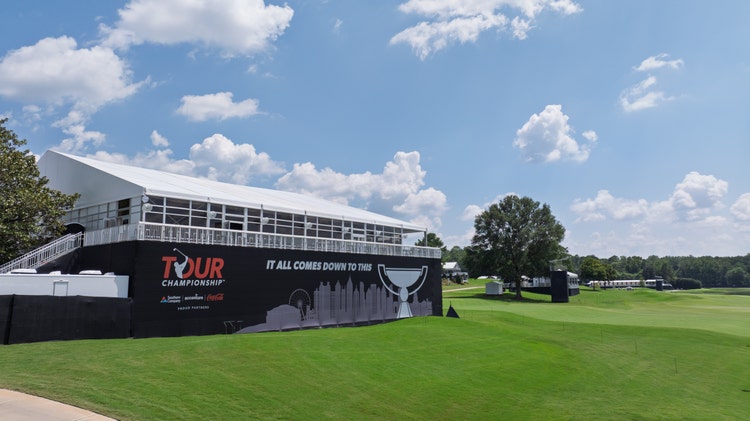
East Lake Golf Club: A Course That Punishes Passive Golf
The Tour Championship is the PGA Tour's season-ending event, first played in 1987 and, since 2007, the final leg of the FedExCup Playoffs. East Lake Golf Club in Atlanta, the historic home course of Bobby Jones, first hosted in 1998 and has been the tournament's permanent venue since 2004.
Bobby Jones is the origin point for almost everything significant at East Lake. East Lake Golf Club has become the defining home of the FedExCup finale. The Atlanta venue brings history, pressure, and a compact leaderboard together on a course where one missed fairway, one poor approach, or one late three-putt can swing the entire season.
The course setup for the Tour Championship is a par 70, which removes the birdie relief that par 5s provide at most Tour stops and places the entire premium on par 4 performance. The par-70 tournament setup removes easy scoring chances, stretches players with long par 4s, and places a premium on choosing the correct side of the fairway for approach angles into protected greens.
What this means in practice: East Lake is a course that punishes passive golf at precisely the moment when passive golf is most tempting. A player who arrives at the Tour Championship knowing they are inside the top 10 of the FedExCup standings might be inclined to manage the week carefully rather than attack. East Lake does not reward that instinct. The closing stretch creates leaderboard drama. Players who have been to East Lake before understand that the back nine on Sunday is not a place where conservative management holds a lead. It is a place where leads evaporate or get extended based on decisions made under full pressure.
East Lake rewards players who can control the ball from tee to green while staying patient. Course rating of 76 and slope of 142 from the championship tees are numbers that communicate something real: this is a course where the scoring average separates from par significantly, and where the player who manages the demanding holes without catastrophic errors outperforms the one who tries to manufacture birdies from positions that do not support them.
Early long par 4s can immediately separate players who control trajectory and distance. The par-5 scoring chances must be handled cleanly because easy birdies are limited.
The Format Change That Matters More Than Most Coverage Acknowledges
For several years, the Tour Championship used a staggered starting strokes format where the FedExCup points leader began the week at 10 under par, with each subsequent player starting at fewer strokes relative to the leader. The format was designed to ensure the FedExCup champion was decided at East Lake rather than through cumulative points across the season.
From 2019 through 2024 the tournament used a staggered "starting strokes" format in which the FedExCup points leader began at 10-under par, so those winning to-par figures are not conventional 72-hole stroke totals; that format was abandoned for 2025, returning the event to a level stroke-play start won by Tommy Fleetwood.
The return to level stroke play starting in 2025 changes the competitive texture of the week in ways that matter for how 2026 plays out. Under the staggered format, the FedExCup standings at the start of the week shaped the entire psychological dynamic: players knew exactly how far they needed to close the gap on the leader, and the week felt less like a golf tournament and more like a strategic positioning exercise. Some players entered knowing they effectively needed to win the tournament to win the FedExCup. Others entered knowing they could finish several shots back of the winner and still claim the season title.
Level stroke play returns the Tour Championship to something more straightforward: the player who shoots the lowest score over 72 holes wins both the tournament and the FedExCup. The psychological simplicity of that structure suits certain players and certain personality types, and it rewards the skill set that 30-player fields with no cut tend to reward: the ability to maintain focus across four consecutive days without the adrenaline spikes that come with cut line pressure or staggered-start mathematics.
Tommy Fleetwood: Defending a Title Won in a Format That Changed What It Meant
Tommy Fleetwood won the 2025 FedExCup Championship at 18 under, 262. The significance of that result extends beyond the scoreline. The launch of ticket sales for the Tour Championship comes just ahead of the PGA Tour's Netflix docuseries, Full Swing Season 4 premiere on Friday, April 17, which features East Lake Golf Club, the Tour Championship, and Tommy Fleetwood's crowning moment as the 2025 FedExCup Champion.
Fleetwood's 2025 victory was the first Tour Championship won under the restored level stroke play format, which means it was also the first clean, direct comparison to pre-staggered era champions in more than five years. His 18 under total is a genuine benchmark rather than an artifact of a staggered starting position. Defending that title at East Lake means defending against a course and a field that both know exactly what it takes to beat him.
Arriving as the defending Tour Championship champion at East Lake is not straightforward. The compressed 30-player field means there is no diluted competition to manage around. Every player in the field qualified for a reason, and the players near the top of the FedExCup standings who arrive at East Lake on the final week of the season are frequently in the form of their year. The defending champion's advantage of course familiarity is real but limited: East Lake is a course that most of the field has played multiple times, and the specific knowledge Fleetwood carries from 2025 is held by the majority of his competitors as well.

The 30-Player Dynamic: What a Small Field Changes
The difference between competing in a 156-player field and a 30-player field is not primarily mathematical. It is psychological and strategic in ways that are worth understanding for anyone following the week closely.
In a standard full-field Tour event, a player who shoots a bad round on Thursday is still competing. The cut line is two days away, and the recovery window is real. In a 30-player no-cut event, a bad Thursday round at East Lake leaves a player needing to make up ground against 29 other elite competitors across three days. The pressure to start well is categorically different from a normal Tour week, and the players who handle that pressure best are not always the ones with the most conventional credentials.
The tournament maintains its traditional stroke play format over par-72 East Lake, one of American golf's most historic venues and the home club of the PGA Tour since 1966.
The leaderboard at the Tour Championship also tends to compress differently than a standard event. With 30 elite players on a course that demands precision over power, the scoring range across the field is narrower than most Tour events. A three-shot lead on Sunday afternoon at East Lake is a real lead but not a comfortable one, and the final round regularly produces movement that would be improbable in a weaker field.
Rory McIlroy is the event's most decorated modern champion at East Lake with wins in 2016, 2019, and 2022. Three wins at the same venue tells you something specific about McIlroy's relationship with East Lake: the course's demands align with what he does best under pressure, which is control the ball from the tee and convert short-range putts when the season is on the line. His record at East Lake is the closest thing to a structural advantage any player brings to the 2026 field, and it matters regardless of where he sits in the FedExCup standings when the week begins.
The $40 Million Purse and What It Means in Context
The event features the PGA Tour's top 30 players competing for $40 million in prize money. The winner's share is $10 million, which is not only the largest individual payout in professional golf outside of the majors but also the culmination of a full season of FedExCup points accumulation.
The $40 million total purse distributed among 30 players produces a per-player average that substantially exceeds any other regular-season Tour event. Even the players who finish last in the 30-player field at East Lake receive a check that most Tour events would not award to a top-10 finisher.
That financial context changes the stakes in a specific way: the Tour Championship is not simply the week with the most money. It is the week that determines which players walk away from the 2026 season having been compensated at the level that their year-long performance deserved. The FedExCup bonus structure rewards consistency across the full season, not just a hot week in August. But the Tour Championship itself is where that consistency is finally monetized, and the players who have spent the year building FedExCup points understand exactly how much is riding on their performance at East Lake.
Attending the 2026 Tour Championship: What to Know Before You Go
The Tour Championship will once again team up with Proud Partner Accenture for complimentary admission for two children ages 15 and under to attend the championship for free with a ticketed adult all week long. The initiative provides families with the opportunity to enjoy the tournament together.
For one week each August, the city's most iconic golf club becomes the place to be, and you do not have to be a golf fanatic to love every minute of it.
The East Lake experience as a spectator is worth understanding before you arrive. Situated in a key stretch on the back nine of East Lake Golf Club near the Rideshare Entrance, the Michelob ULTRA Club is an open-air, shaded hospitality venue offering an ideal place to refresh just steps from hole nos. 16 and 17. Featuring soft seating, televisions, covered and outdoor seating, this venue offers complimentary beer, seltzer, non-alcoholic options and soda, with other beverages and food available for purchase.
Experience the PGA Tour's season-ending event like never before with tickets to The Georgian presented by PGA Tour Superstore. Featuring all-inclusive food and beverage, this climate-controlled venue is centrally located amidst the action and offers plenty of space to network, meet and engage with clients or colleagues. Plus, enjoy expansive patio seating with sightline of Nos. 8 and 9 and panoramic views towards No. 1 tee and the iconic East Lake Clubhouse.
Check the forecast before you pack. Layered clothing, sunscreen, and comfortable walking shoes are essentials for a full day on the grounds. Most PGA Tour venues allow one sealed water bottle; clear-bag policies apply at many gates. Late August in Atlanta means heat and humidity that require preparation, and the players dealing with those conditions across four rounds are managing the same environment you will be navigating on the grounds.
Tickets for all four tournament days are available at TOURChampionship.com.


.jpg)
.jpg)


.png)
.png)